
News
The latest issue of the design magazine "AXIS," Vol. 238, goes on sale October 1!
Press Relese
26.10.01
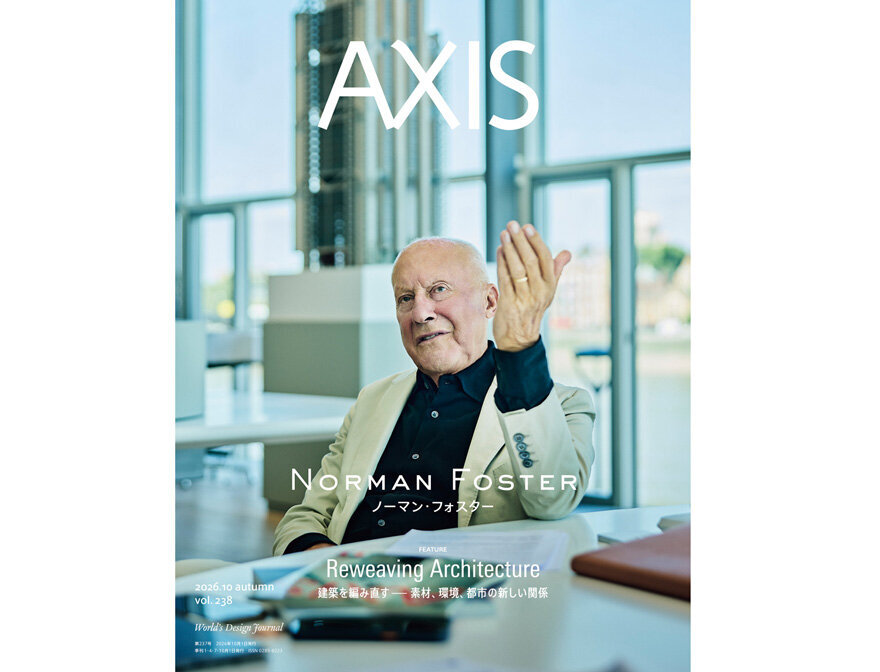
Axis Co., Ltd. (Minato-ku, Tokyo; President and CEO: Juhei Shimazaki) released the latest issue, Vol. 238, of its design magazine "AXIS" on Thursday, October 1, 2026.
COVER STORY
Norman Foster(Foster + Psrtners)
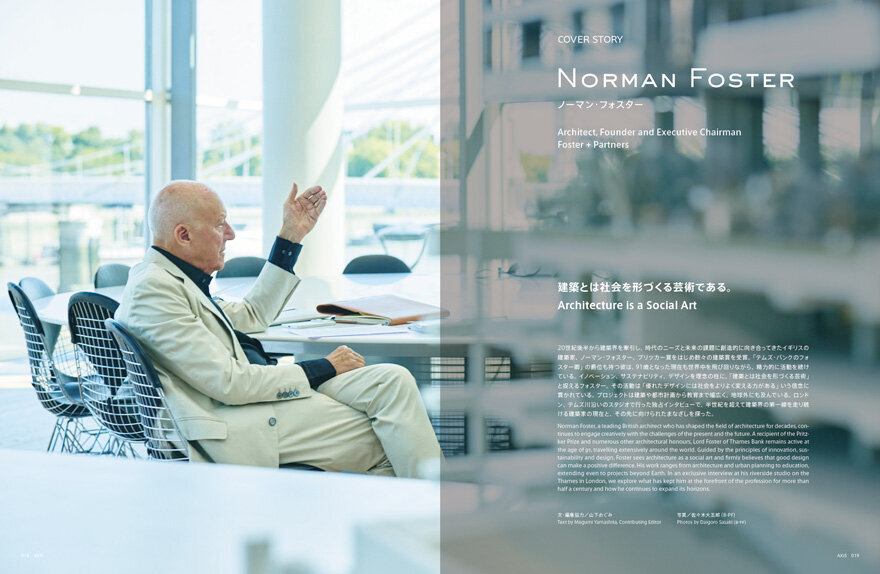
Architecture is a Social Art
Norman Foster, a leading British architect who has shaped the field of architecture for decades, continues to engage creatively with the challenges of the present and the future. A recipient of the Pritzker Prize and numerous other architectural honours, Lord Foster of Thames Bank remains active at the age of 91, travelling extensively around the world. Guided by the principles of innovation, sustainability and design, Foster sees architecture as a social art and firmly believes that good design can make a positive difference. His work ranges from architecture and urban planning to education,extending even to projects beyond Earth. In an exclusive interview at his riverside studio on the Thames in London, we explore what has kept him at the forefront of the profession for more than half a century and how he continues to expand its horizons.
Feature
Reweaving Architecture
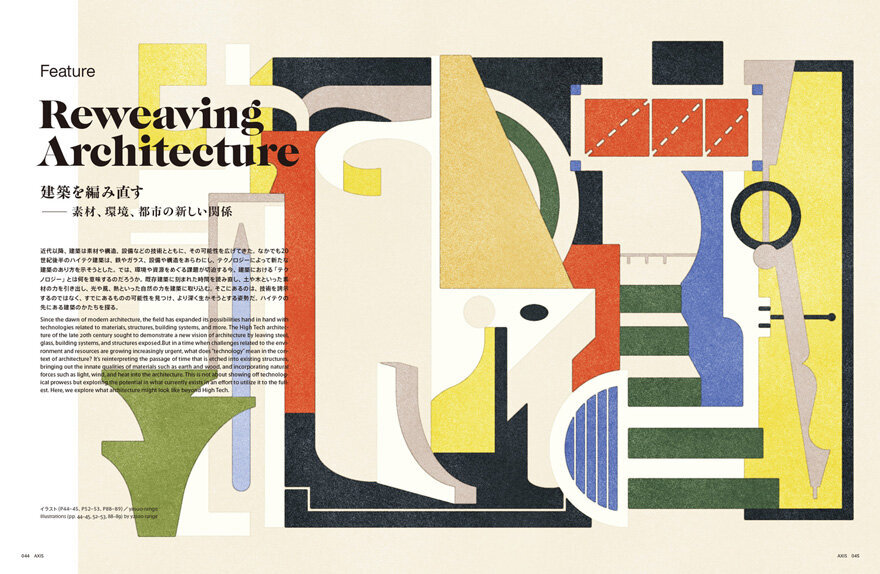
Since the dawn of modern architecture, the field has expanded its possibilities hand in hand with technologies related to materials, structures, building systems, and more. The High Tech architectureof the late 20th century sought to demonstrate a new vision of architecture by leaving steel,glass, building systems, and structures exposed.But in a time when challenges related to the environment and resources are growing increasingly urgent, what does "technology" mean in the context of architecture? It's reinterpreting the passage of time that is etched into existing structures,bringing out the innate qualities of materials such as earth and wood, and incorporating natural forces such as light, wind, and heat into the architecture. This is not about showing off technological prowess but exploring the potential in what currently exists in an effort to utilize it to the fullest.Here, we explore what architecture might look like beyond High Tech.
Introduction
Looking back at the future of architecture ーWhat has technology really changed?
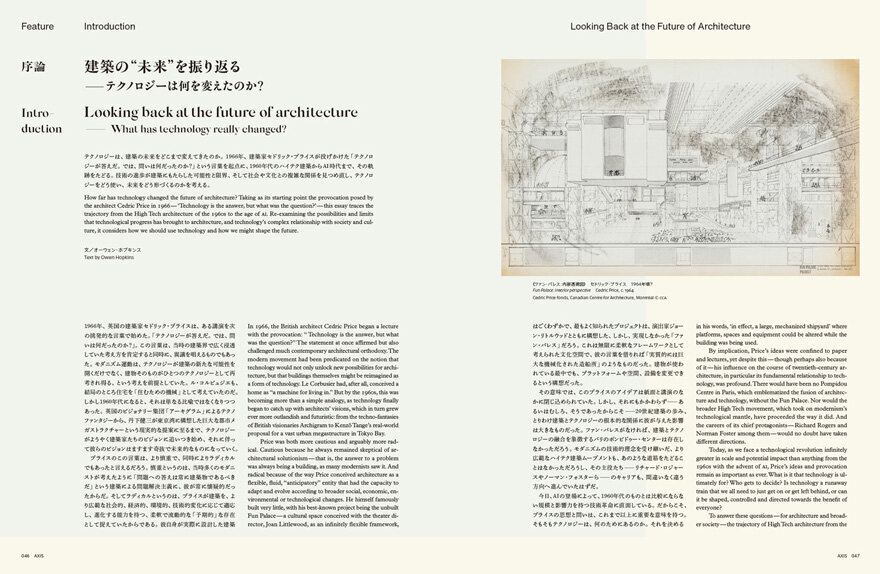
How far has technology changed the future of architecture? Taking as its starting point the provocation posed by the architect Cedric Price in 1966--'Technology is the answer, but what was the question?'--this essay traces the trajectory from the High Tech architecture of the 1960s to the age of AI. Re-examining the possibilities and limits that technological progress has brought to architecture, and technology's complex relationship with society and culture,it considers how we should use technology and how we might shape the future.
Chapter_1 Editing Architecture
Case_1 From grain silos to art museum:Architecture that preserves an industrial heritage for future generations
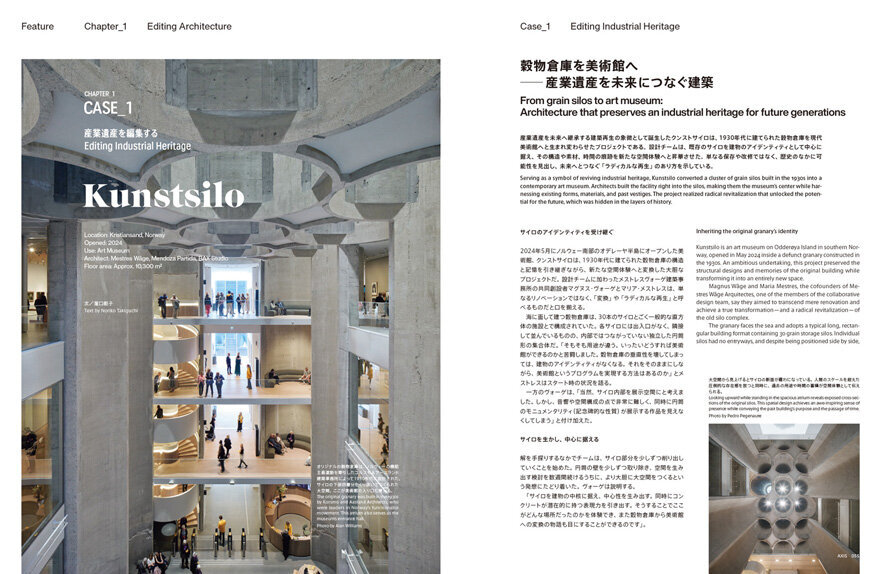
Serving as a symbol of reviving industrial heritage, Kunstsilo converted a cluster of grain silos built in the 1930s into a contemporary art museum. Architects built the facility right into the silos, making them the museum's center while harnessing existing forms, materials, and past vestiges. The project realized radical revitalization that unlocked the potential for the future, which was hidden in the layers of history.
CASE_2 Editing the Urban Commons
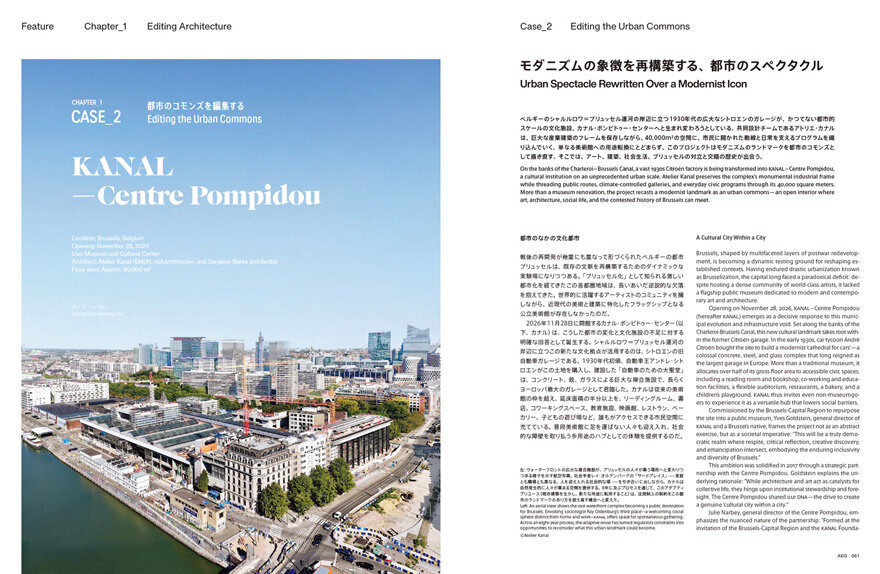
On the banks of the Charleroi-Brussels Canal, a vast 1930s Citroën factory is being transformed into KANAL-Centre Pompidou,a cultural institution on an unprecedented urban scale. Atelier Kanal preserves the complex's monumental industrial frame while threading public routes, climate-controlled galleries, and everyday civic programs through its 40,000 square meters.More than a museum renovation, the project recasts a modernist landmark as an urban commons--an open interior where art, architecture, social life, and the contested history of Brussels can meet.
Conversation: Daisuke Nagano × Tsuyoshi Tane
Architecture That Inherits Time
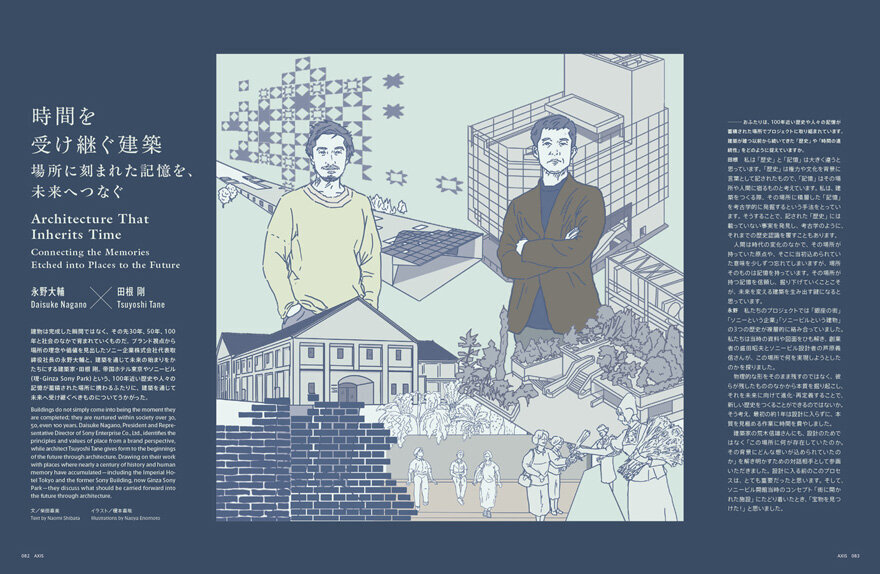
Buildings do not simply come into being the moment they are completed; they are nurtured within society over 30,50, even 100 years. Daisuke Nagano, President and Representative Director of Sony Enterprise Co., Ltd., identifies the principles and values of place from a brand perspective,while architect Tsuyoshi Tane gives form to the beginnings of the future through architecture. Drawing on their work with places where nearly a century of history and human memory have accumulated--including the Imperial Hotel Tokyo and the former Sony Building, now Ginza Sony Park--they discuss what should be carried forward into the future through architecture.
Chapter_2 Architecture Shaped by Materials
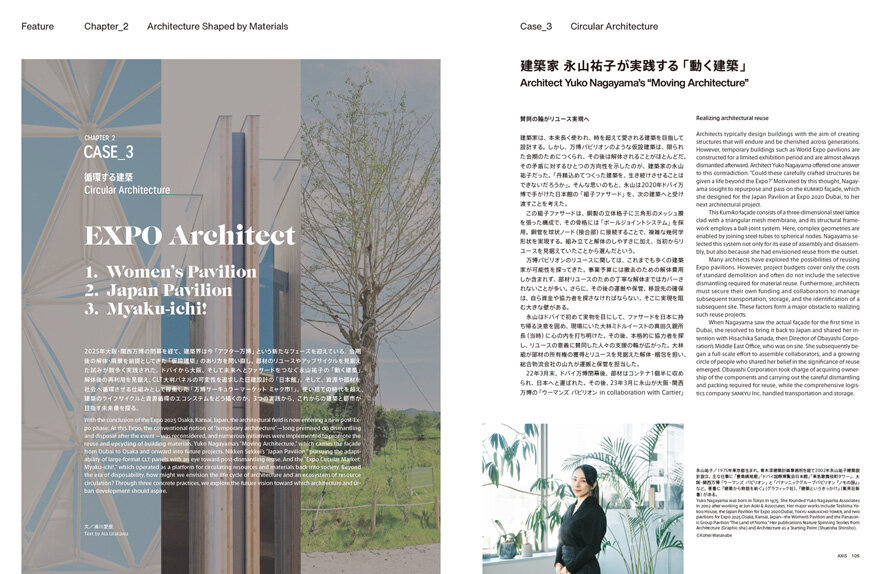
Case_3 Architect Yuko Nagayama's "Moving Architecture"
How do Ettore Sottsass's works, activities, and underlying philosophy resonate into today's design? We examined the insights of various individuals connected to Sottsass ――including a gallerist handling Memphis Milano works, a design coordinator living in a Sottsass-designed house, leaders of local industries, as well as designers, architects, and illustrators who say they were deeply influenced by him. A diverse portrait of Sottsass emerges through these varied perspectives.
Contents
COVER STORY
Norman Foster (Foster + Partners)
FEATURE Reweaving Architecture
■Introduction: Looking back at the future of architecture--What has technology really changed?
■Chapter_1 Editing Architectur
Case_1 Kunstsilo
Case_2 KANAL-Centre Pompidou
Case_3 MADD (Musée des Arts Décoratifs et du Design Bordeaux)
■Beyond Structure: New perspectives on reading architecture Hufton + Crow
■Conversation: Architecture That Inherits Time Daisuke Nagano x Tsuyoshi Tane
■Chapter_2 Architecture Shaped by Materials
Case_1 Alnatura Campus
Case_2 World of Volvo
Case_3 EXPO Architect
ーArchitect Yuko Nagayama's "Moving Architecture"
ーNIKKEN SEKKEI's Challenge--Reusing building materials for the Japan Pavilion
ーThe future of a circular society as revealed by Myaku-ichi!
■The Transformation of Architecture in the City of London
■How Seoul Re-edits Its Spatial Legacy
■Architecture that generates energy: Powerhouse Brattørkaia
SCOPE
Invisible Beauty--Arc'teryx's Philosophy Embodied in the Seam
SERIES
Ambience Afterimage Kanade Hamamoto LEADERS Asako Iwayanagi (Pastry Chef)
Sci-Tech File Final Installment Uncovering hidden plant communication
using imaging technology Keiichiro Fujisaki
DESIGN FOR DECISION-MAKING
Systemic Design through relations:
Connecting complex issues to value circulation Shunsuke Ishikawa (KESIKI)
AFRICAN PRACTITIONERS Osmond Tshuma (Graphic artist, typeface designer) Maki Nakata
From a single piece SMBC Visual Identity System (2001) Sakura Nomiyama
1TIMELESS INGENUITY Final Installment The origins and future direction of humanity Chihiro Minato
Designer's Eye A compact space Keisuke Nakamura
Exercises in Poetic Engineering A sensation humanity has never experienced before Shohei Takei (nomena)
To perceive the actuality When the net disappears Haruka Misawa
Creators Navi Kotaro Usugami, Studio WAK, Tamotsu Ito, KANAISASAKI, Mae Engelgeer
AXIS Media Membership
Design Magazine AXIS Back number
For purchase