
News
Special Issue "Nikken Green Journey ―Designing the future of city and nature" on Sale !
Press Relese
25.12.23
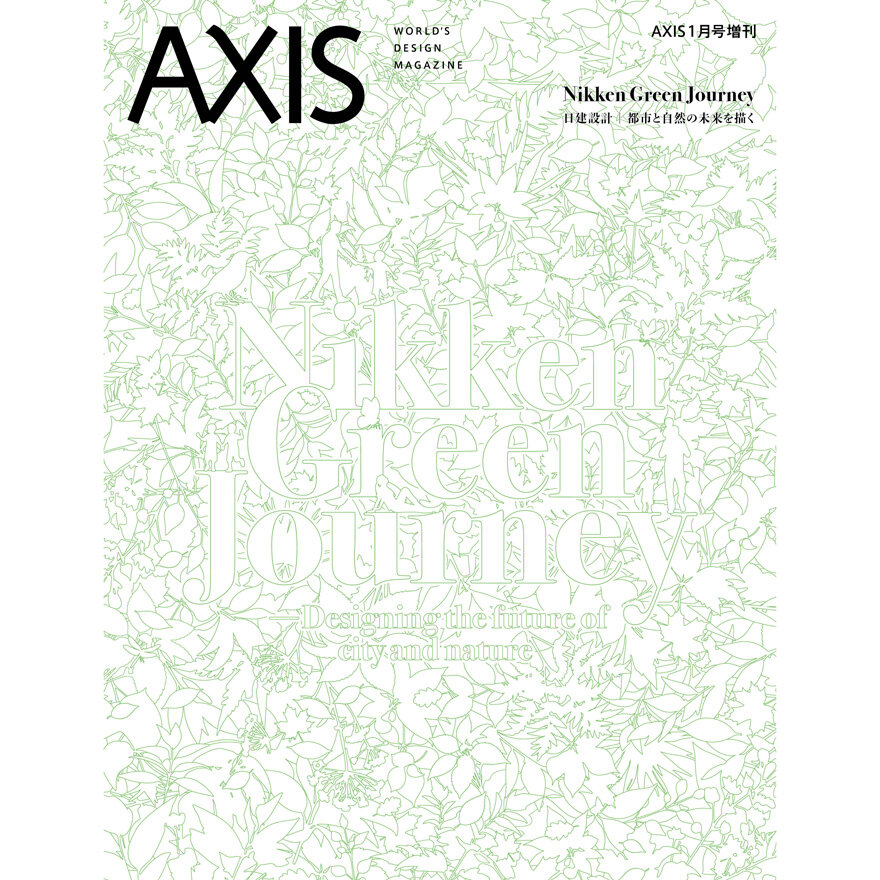
AXIS Co., Ltd. (Minato-ku, Tokyo; President and Representative Director: Nobuo Asaka) has released a special issue of Design Magazine AXIS published on December 15, 2025, titled "Nikken Green Journey ―Designing the future of city and nature".
The accelerating pace of global warming, a succession of natural disasters, and the continuing loss of biodiversity ―we are now compelled to fundamentally rethink how we relate to nature. Under the theme of Green Recovery, Nikken Sekkei has explored visions for nature-positive cities, strategies for restoring greenery, and ways to make the value of green spaces visible. Drawing on the outcomes of these studies, this volume follows Nikken Sekkei's landscape architects as they engage in dialogues with leading experts and embark on journeys through cities and landscapes across the world, seeking new possibilities for the future.
NIKKEN SEKKEI LTD https://www.nikken.co.jp/en/
Tripartite Discussion
Why consider the future of city and nature now?
Noriko Matsuda, Associate Professor (PhD) at Kyoto Prefectural University, with Yoshiaki Komatsu and Shoji Kaneko of Landscape Design Group, Urban and Civil Project Department, Nikken Sekkei
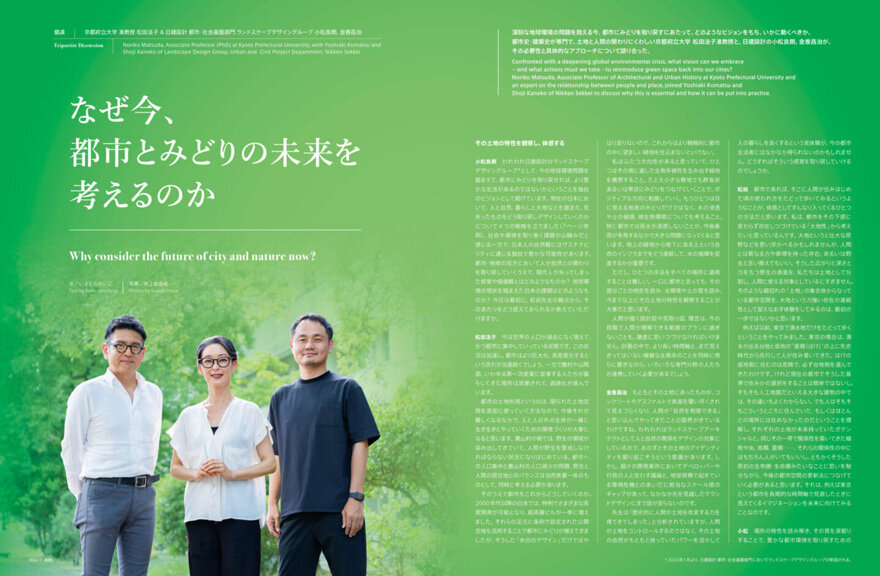
Confronted with a deepening global environmental crisis, what vision can we embrace --and what actions must we take--to reintroduce green space back into our cities? Noriko Matsuda, Associate Professor of Architectural and Urban History at Kyoto Prefectural University and an expert on the relationship between people and place, joined Yoshiaki Komatsu and Shoji Kaneko of Nikken Sekkei to discuss why this is essential and how it can be put into practice.
Four Strategies for Recovering Greenery in Cities 01
Bringing nature closer to urban areas through its integration with architecture
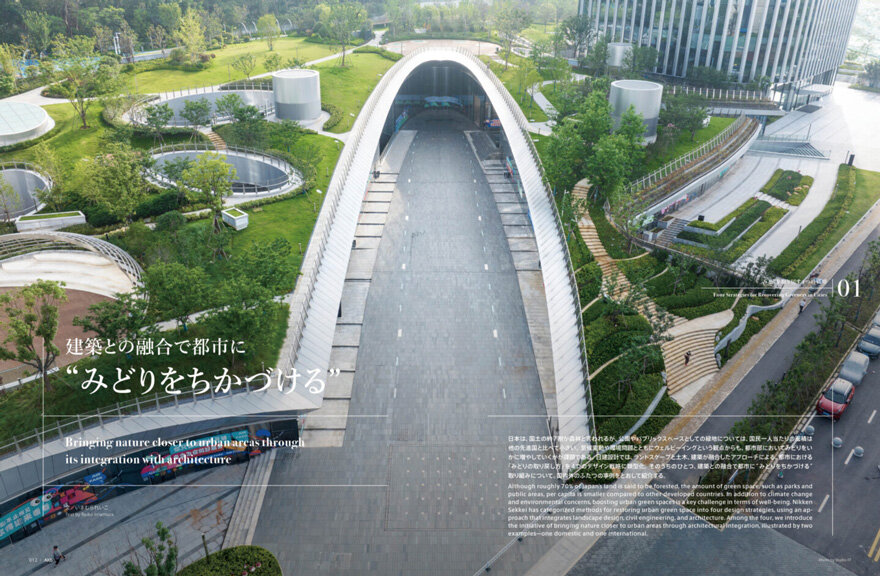
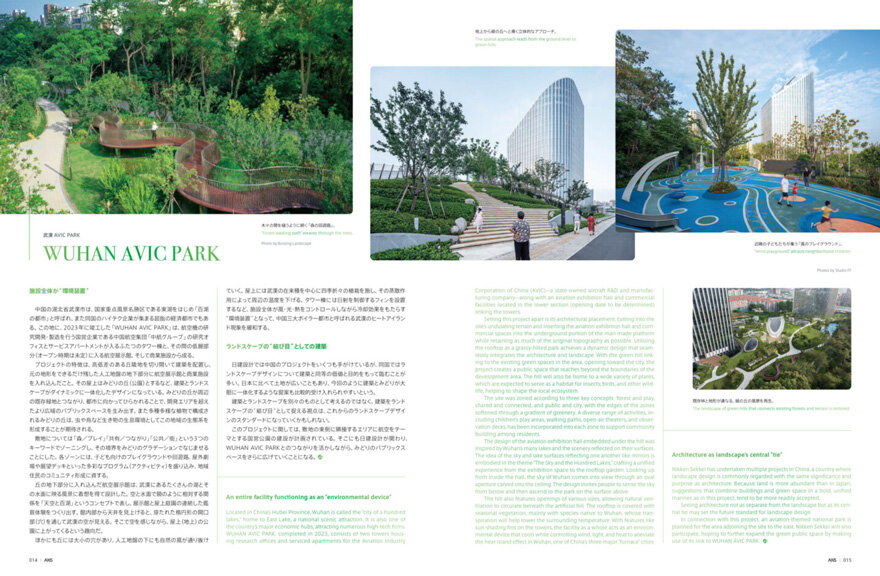
Although roughly 70% of Japan's land is said to be forested, the amount of green space, such as parks and public areas, per capita is smaller compared to other developed countries. In addition to climate change and environmental concerns, boosting urban green spaces is a key challenge in terms of well-being. Nikken Sekkei has categorized methods for restoring urban green space into four design strategies, using an approach that integrates landscape design, civil engineering, and architecture. Among the four, we introduce the initiative of bringing nature closer to urban areas through architectural integration, illustrated by two examples--one domestic and one international.
Four Strategies for Recovering Greenery in Cities 02
Connecting urban nature with POPS (Privately Owned Public Spaces)
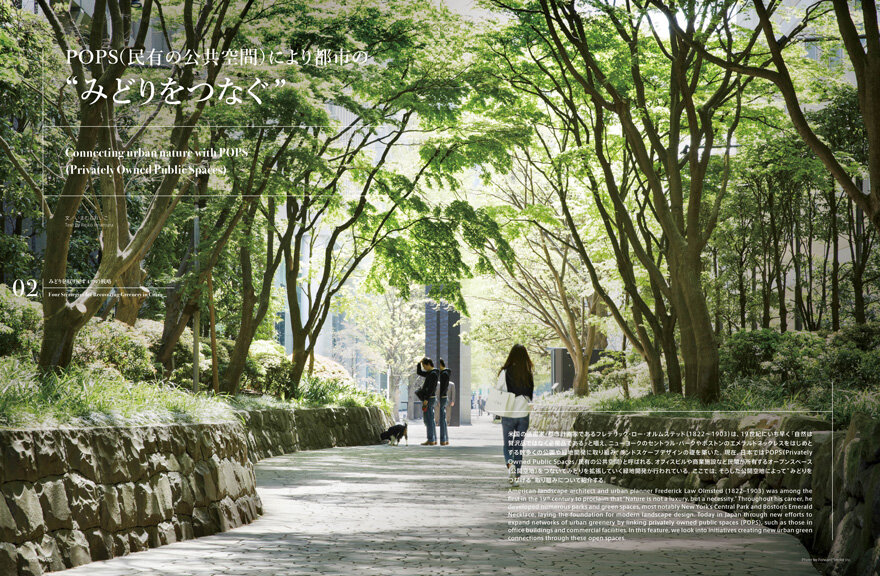
American landscape architect and urban planner Frederick Law Olmsted (1822-1903) was among the first in the 19th century to proclaim that "Nature is not a luxury, but a necessity." Throughout his career, he developed numerous parks and green spaces, most notably New York's Central Park and Boston's Emerald Necklace, laying the foundation for modern landscape design. Today in Japan through new efforts to expand networks of urban greenery by linking privately owned public spaces (POPS), such as those in office buildings and commercial facilities. In this feature, we look into initiatives creating new urban green connections through these open spaces.
Four Strategies for Recovering Greenery in Cities 03
Enriching the public realm with civic engagement
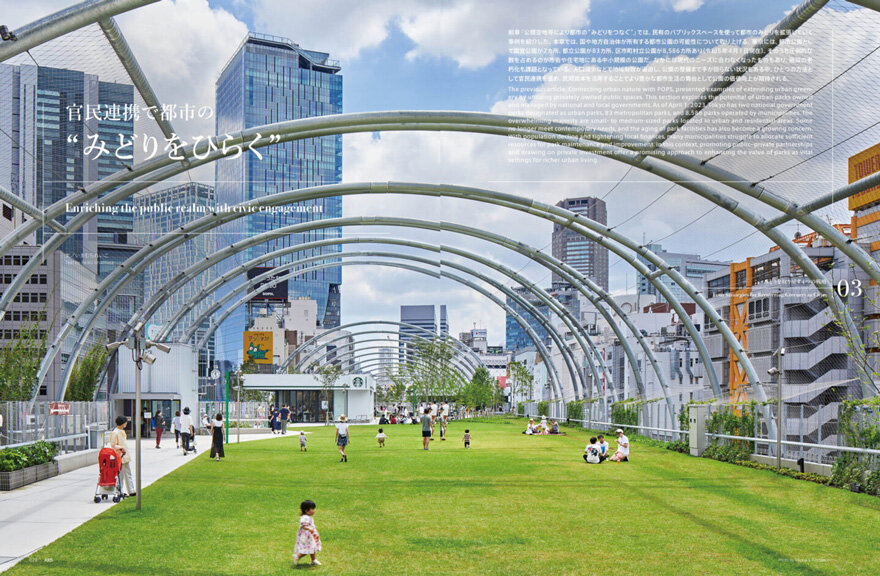
The previous article, Connecting urban nature with POPS (Privately Owned Public Spaces), presented examples of extending urban greenery by utilizing privately owned public spaces. This section explores the potential of urban parks owned and managed by national and local governments. As of April 1, 2023, Tokyo has two national government parks designated as urban parks, 83 metropolitan parks, and 8,586 parks operated by municipalities. The overwhelming majority are small- to medium-sized parks located in urban and residential areas. Some no longer meet contemporary needs, and the aging of park facilities has also become a growing concern. With population decline and tightening local finances, many municipalities struggle to allocate sufficient resources for park maintenance and improvement. In this context, promoting public-private partnerships and drawing on private investment offer a promising approach to enhancing the value of parks as vital settings for richer urban living.
Four Strategies for Recovering Greenery in Cities 04
Expanding greenery through infrastructure renewal
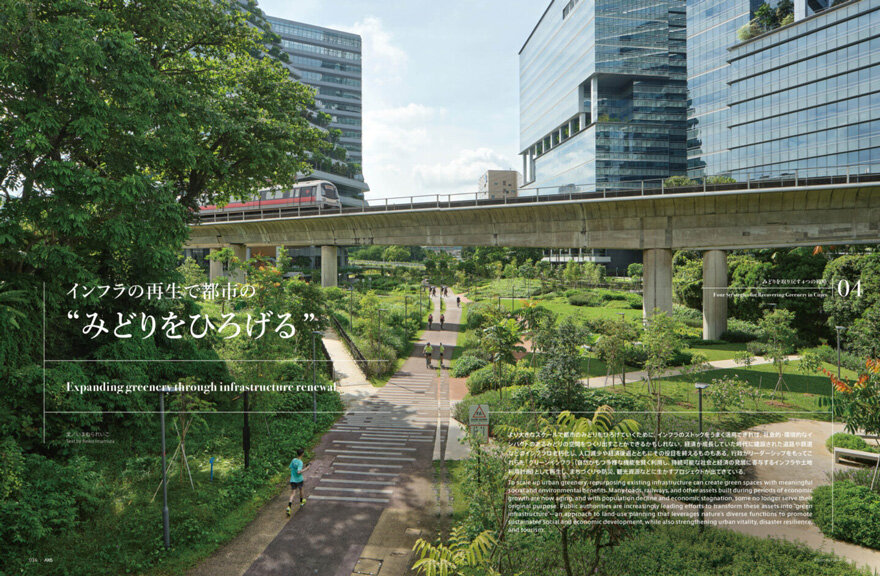
To scale up urban greenery, repurposing existing infrastructure can create green spaces with meaningful social and environmental benefits. Many roads, railways, and other assets built during periods of economic growth are now aging, and with population decline and economic stagnation, some no longer serve their original purpose. Public authorities are increasingly leading efforts to transform these assets into "green infrastructure"--an approach to land-use planning that leverages nature's diverse functions to promote sustainable social and economic development, while also strengthening urban vitality, disaster resilience, and tourism.
Tripartite Discussion
Through the history and philosophy of landscape design
Akiko Iida, Project Lecturer at School of Engineering, The University of Tokyo, with Taku Suzuki and Hiroki Yagi of Landscape Design Group, Urban and Civil Project Department, Nikken Sekkei
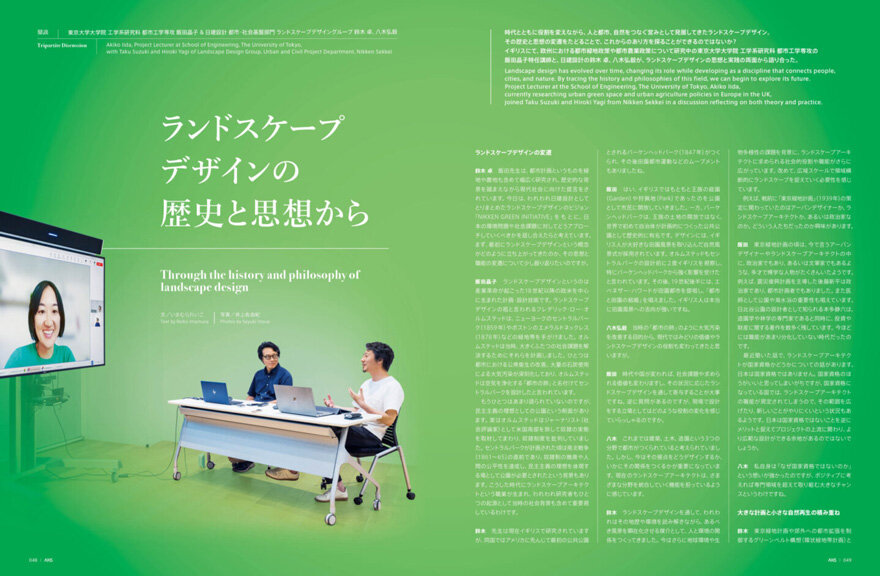
Landscape design has evolved over time, changing its role while developing as a discipline that connects people, cities, and nature. By tracing the history and philosophies of this field, we can begin to explore its future. Project Lecturer at the School of Engineering, The University of Tokyo, Akiko Iida, currently researching urban green space and urban agriculture policies in Europe in the UK, joined Taku Suzuki and Hiroki Yagi from Nikken Sekkei in a discussion reflecting on both theory and practice.
Discussion
A vision of city and greenery seen through dialogue on Grand Green Osaka
Architect Ryuji Fujimura with Yoshiaki Komatsu of Landscape Design Group, Urban and Civil Project Department, Nikken Sekkei
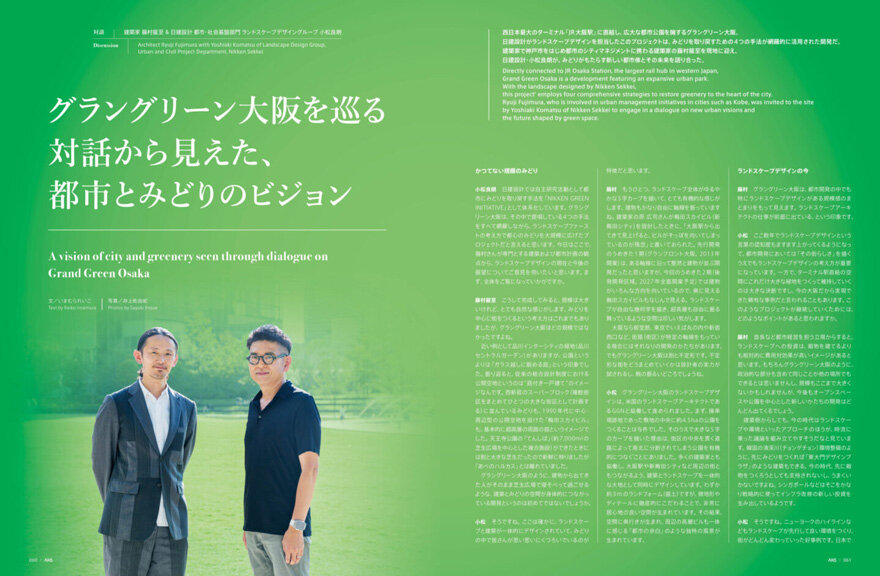
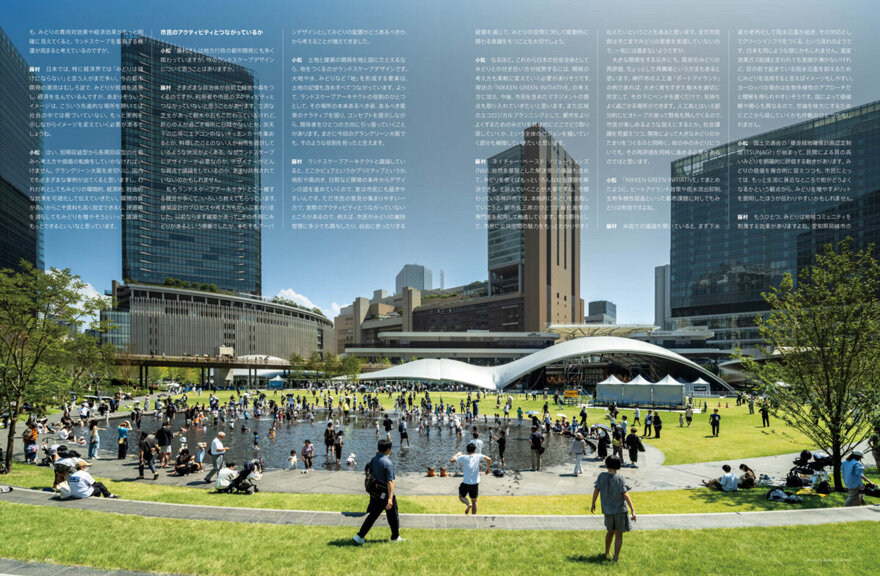
Directly connected to JR Osaka Station, the largest rail hub in western Japan, Grand Green Osaka is a development featuring an expansive urban park. With the landscape designed by Nikken Sekkei, this project* employs four comprehensive strategies to restore greenery to the heart of the city. Ryuji Fujimura, who is involved in urban management initiatives in cities such as Kobe, was invited to the site by Yoshiaki Komatsu of Nikken Sekkei to engage in a dialogue on new urban visions and the future shaped by green space.
Contents
Tripartite Discussion 「Why consider the future of city and nature now?
Noriko Matsuda, Associate Professor (PhD) at Kyoto Prefectural University, with Yoshiaki Komatsu and Shoji Kaneko of Landscape Design Group, Urban and Civil Project Department, Nikken Sekkei
Four Strategies for Recovering Greenery in Cities
Bringing nature closer to urban areas through its integration with architecture/ Connecting urban nature with POPS (Privately Owned Public Spaces)/ Enriching the public realm with civic engagement/ Expanding greenery through infrastructure renewal
Tripartite Discussion Through the history and philosophy of landscape design
Akiko Iida, Project Lecturer at School of Engineering, The University of Tokyo, with Taku Suzuki and Hiroki Yagi of Landscape Design Group, Urban and Civil Project Department, Nikken Sekkei
Discussion Envisioning tomorrow's landscapes
Mamoru Taniguchi, Professor at the Institute of Systems and Information Engineering, Division of Policy and Planning Sciences, University of Tsukuba, with Daisuke Nishi of Landscape Design Group, Urban and Civil Project Department, Nikken Sekkei
Discussion A vision of city and greenery seen through dialogue on Grand Green Osaka
Architect Ryuji Fujimura & Yoshiaki Komatsu, Landscape Design Group, Urban and Civil Project Department, Nikken Sekkei
Midori no Monosashi "Greenery Gauge"
A guide to creating better spaces
Roundtable Discussion The new landscape ahead-Insights from Nikken Green Journey
Akinori Kuramoto, Yuki Iwata, Yuzo Okawa, and Tomoko Hirayama of Landscape Design Group, Urban and Civil Project Department, Nikken Sekkei
The history of the relationship between cities, people, and nature
Social change seen through landscape (1980-2025)
In search of landscaping that connects to the future
Nikken Sekkei's landscape design challenge
About Special Issue
In a special issue of Design Magazine AXIS, we introduce the design activities and projects of corporate organizations. We want to show not only those involved but also the readers what we are doing by systematically discussing our vision and philosophy for the future.
For purchase